

Pair of articulated brass wall lights, topped with delicate pink silk-lined shades adorned with elegant Houlès passementerie. Fully adjustable, they can be positioned in both height and width, allowing them to adapt harmoniously to a variety of spaces. Their soft, diffused light is ideal for creating a warm and refined atmosphere. Rewired to current electrical standards.

This type of regional jewel is known as the “Heart of Mary” (Vlaamse Hart), which translates as “Flemish Heart.” Originating in Antwerp, its production began in the late 18th century. Our example is decorated with silver interlacing set with small rose-cut diamonds, together with a larger diamond at the center of the pendant. The whole is surmounted by a crown of flowers.


This late-19th-century painting on wood depicts an intimate scene, capturing the kiss exchanged between two young children shown in bust-length portrait. On the left, a little girl, seen from the front and dressed in a white shirt or nightgown with puffed sleeves, smiles. On the right, a second child, probably her brother, dressed in a garment with a ruffled collar, leans over to kiss his sister on the cheek.
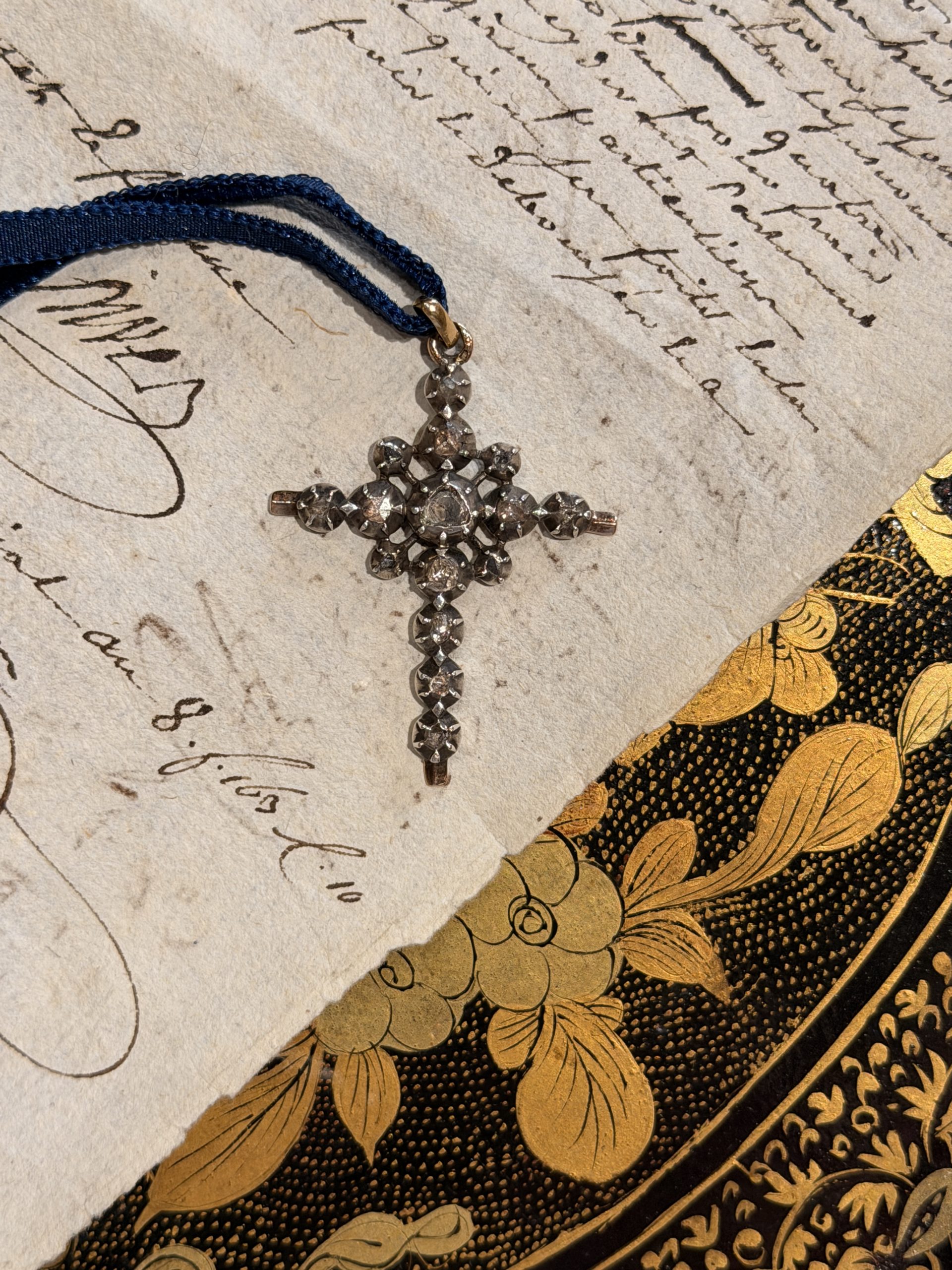
Pendant in the shape of a cross, situated at the meeting point between two models. Indeed, its shape clearly refers to the “Marie-Antoinette” cross, which was nonetheless surmounted and supported on the chain by a bow, an element absent on our cross. These crosses are characterised at their centre by a rounded form, created by the arrangement of the stones in relation to one another.

This object was associated with the funerary traditions of the clergy and nobility and was intended to hold the heart and other viscera, which were subsequently buried in churches or chapels. If such boxes were later repurposed towards the end of the 18th century, this was precisely due to the evolution of these funerary practices. This may explain why they are sometimes referred to as “tobacco boxes” or “pigment boxes.”

A set of six wooden chairs entirely clad in repoussé silver leaf, featuring interlacing patterns, scrolling foliage, and floral motifs. The backrest is adorned at its ends with two rams’ heads in relief, lending the set a highly decorative character.

A lacquer tray, fitted with a gilt-bronze mount, supports the various elements, which are secured to it by small rivets. Among them is a Chinese dignitary figure in famille verte porcelain, Qing dynasty, Kangxi period (1662–1722). Two porcelain bird whistles, in the form of reclining boys with their heads raised and supported by their hands, are also present. The details of their floral robes are highlighted in red, blue, green and black enamels. Circa 1700, Japan, Arita kilns.

This cast iron garden bench reflects the Victorian taste of the second half of the19th century. Its structure features naturalistic decoration with scrolling foliage, vine leaves and other botanical motifs. The backrest and seat are entirely piercedwith an openwork design. The whole rests on two finely worked legs, connected by metal reinforcing elements.